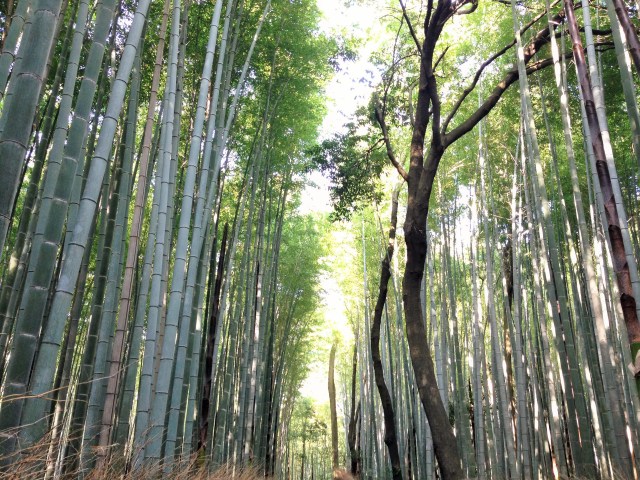
Next to Tenryuji Temple is the infamous Sagano Bamboo Forest. I was very excited to check this out as I was expecting never ending columns and columns of bamboo as the word forest implies. However, it was only approximately two blocks of bamboo and was polluted with people. It was not as calm and peaceful as I hoped it to be.
This guy did a great job of portraying the nature of the bamboos.
Tenryuji is the most important zen temple of the Arashiyama district of Kyoto. Built in 1339 by shogun Ashikaga Takaui in honor of late Emperor Go-Daigo. It is now a UNESCO world heritage site.
Zen garden when you first walk into the temple.
Many of its original buildings were lost overtime to fire and wars. Its current buildings were rebuilt during the Meiji period. The original garden created by Muso Soseki, the first priest of Tenryuji, still stands today.
Overall, I didn’t find this temple to be impressive. Maybe because I saw too many temples and was tired of them at this point. I enjoyed the zen garden of Kodaiji Temple more.
To get to the heart of the park, you have to hike up steep and sometimes broken terrain. Tip: Wear comfortable shoes and bring water as the trail is mostly in the sun.
After 20 minutes of strenuous uphill, you will forget about the hike once you spot the free roaming Japanese macaque monkeys.
At the top, there is a feeding hut, which is the only place you are allowed to feed the monkeys. If you feed them outside the hut, they can become aggressive.
For 100 yen, you can buy a bag of peanuts or apples to feed the monkeys.
The fatty on the left kept stuffing his mouth with peanuts until he became a chubby bunny. I was shocked to see the monkeys knew to reach their hand out for more food.
Outside of the feeding hut, the monkeys roam around freely. However, you are not allowed to make eye contact with the monkeys or touch them.
This little guy was my favorite.
Instead of asking for food, he decided to hunt for his own.
Peace out homies. It’s naptime. Fun fact: The monkeys have red faces due to the blood rushing to their face.
Last but not least, don’t forget to turn around and enjoy the gorgeous view of Kyoto.
Formally known as Rokuon-ji Temple, but infamously known as Kinkakuji or the Golden Pavilion, this temple was built during the Muromachi period. It was previously the retirement villa of the third shogun Ashikaga Yoshimitsu but became a zen temple after his death.
Gold foil covers the top two levels of the temple while a phoenix sits atop the temple.
You are allowed to roam the rest of the temple grounds, however, there is not much to see.
Kodaiji temple was my favorite temple on this trip. The zen qualities of the temple was soothing among the busy rhythm of this trip.
This temple was built in 1605 by Kita-no-Mandokoro, also known as Nene, in honor of her late husband Toyotomi Hideyoshi. However the temple is named after Kita-no-Mandokoro’s honorary name Kodai-in.
Peaceful zen stone garden in front of the main hall.
Kaisan-do, Founder’s Hall, with bonsai trees.
Hojo, main hall, rebuilt after being burned down in 1912.
Garyoro corridor, named after the resemblance to the back of a reclining dragon.
Mausoleum enshrining Toyotomi and Nene.
Shigure-tei teahouse constructed by bamboo and logs interwoven in a radiating pattern.
Next up on my house plans will be a bamboo forest.
After wandering around Kyoto all day, we were starving and on the hunt for good food. After much research, we settled on Ganko Sanjo Honten. Like all good food in Japan, it is a chain so you don’t have to travel all the way to Kyoto to try it. I noticed them in every city we visited. They also have branches that serve only ramen or gyoza. It’s easy to spot as the tough Japanese chef is their logo and their entrances are known for its overwhelming displays of plastic food.
We sat at the counter and had an fun experience communicating with the chef as he only spoke Japanese and we knew little to none.
Toro, boiled crab, and salmon. Despite its appearance, the salmon was smooth and fresh; I ordered it twice.
Negi toro roll was nothing special.
I noticed everyone ordered eel, so I too had to try and it was deliciously sweet and toasted! The unagi had gone through the toaster twice. The uni in the back was mediocre. Sadly the chef served us from the bottom tray of uni, which didn’t look as nice as the top display tray.
Overall, the sushi was mediocre. Some were amazing, like the salmon and unagi, but nothing to fawn about.
Kiyomizu-dera is the temple of pure water because it was built around the Otowa waterfall, which flows spring water from the mountain. The temple has been burned down several times, a reoccurring theme in Japan it seems. The current buildings were rebuilt during the Edo period. The temple is now a UNESCO World Cultural Heritage site.
Deva Gate
West Gate
Hideously colored pagoda
The main hall (hondo) houses the eleven faced and thousands armed statue of Kannon. The infamous extended Kiyomizu stage is made out of wood 12 meters high and held together without nails.
No nails used to support the stage….
You may drink the water from the Otowa waterfall. Each stream represents longevity, academic success, or fortunate love life. You may drink from more than one stream but to drink from all three streams is seen as greedy.
Loved the spring mountain back drop.
View of Kyoto.
Secret pagoda for some peace and quiet away from the people pollution.
Home to the infamous thousands of red (vermillion) torii gates shrine. Below is the Romon Gate donated by Toyotomi Hideyoshi in 1589. Behind it is Honden, the main shrine building.
Fushimi Inari is named after the mountain it sits atop, Mount Inari,
and the Shinto god of rice it gives homage to, Inari. Foxes are known to be Inari’s messengers. Therefore, you will see them everywhere before the shrines.
Beginning of the ascent to the thousands of red torii gates.
One of the many mini shrines that dot the mountain.
Senbon trail is the parallel rows of mini torii gates. Each torii gate is donated either by an individual or company in hopes of prosperity. The small gates start at 400,000 yen while the larger ones can cost up to 1 million yen.
One is not like the other.
After about a 40 min ascent, you will come across Yotsutsuji intersect with a view of Kyoto. Tip: Bring some snacks and water with you as it is mostly uphill. Onigiri is a small and filling snack. 7-11 offers a decent variety.
If you’re adventurous, you can continue the path for another 1.5- 2.5 hours to reach the full summit.


 YUMTRAVELS