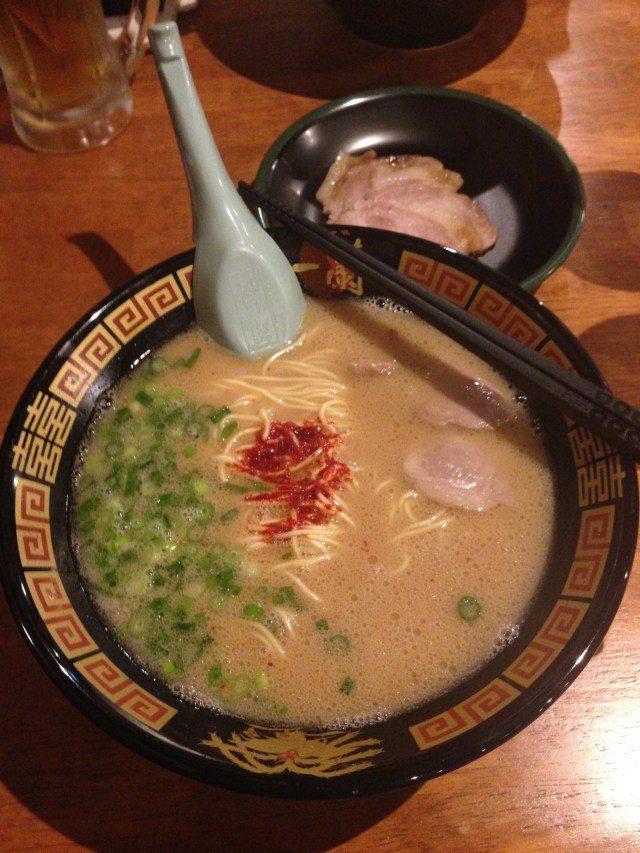
Like everything else in Japan, Ichiran is a chain restaurant. They specialize in ramen with tonkotsu broth. To order, buy your meal ticket at the vending machine. You have the option to add more pork, green onions or an egg for additional costs. Once you’ve purchased your meal ticket, the hosts will guide you to an open table. You have the option to sit at individual booth like eating area or at open tables. At the table, you fill out a form customizing your broth and noodle preferences. The broth was porky but not deep in flavor. The noodles were the perfect chewiness. One dislike was that they forgot our egg until I remembered at the end of meal. Overall, it was a satisfying bowl of ramen.
Next to Dotonbori is Osaka’s shopping mecca Shinsaibashi. You can easily get lost in the never ending row of stores selling clothes, souvenirs, and jewelry. Beware of the hordes of tourists. I was expecting the tourists to be in Tokyo but soon learned they were all in Shinsaibashi.
Lured by the sweet fresh out of the oven smell of a cream puff, I stopped at the Hop Chou a la Creme stall for a chocolate cream puff filled with matcha custard. The shell was crispy and the matcha cream was sweet and delicious.
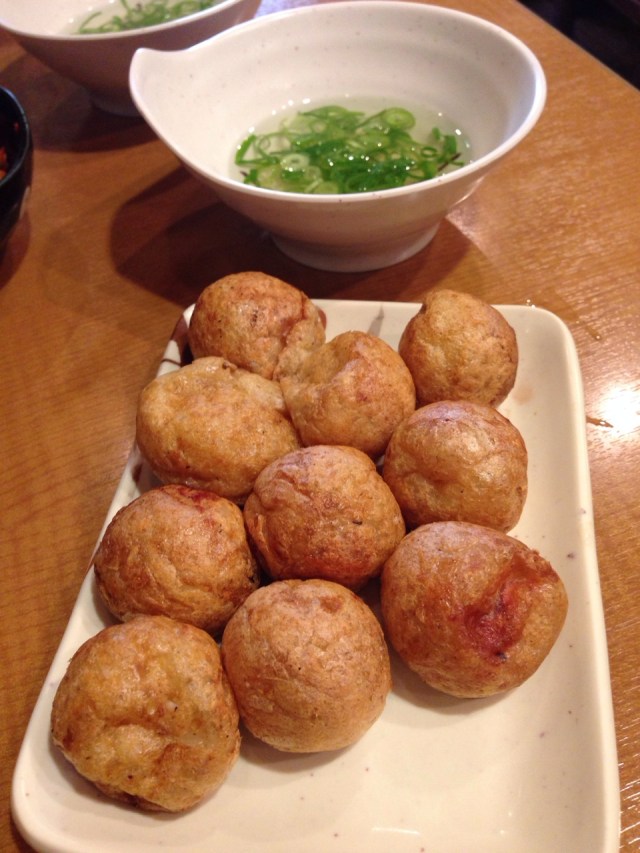
Aizuya is the birthplace of takoyaki. Tako means octopus and yaki means to fry or to cook in Japanese. Due to food shortages in the twentieth century, wheat flour was sent over to Japan by the US as a relief after World War II. It became more popular than rice, which wasn’t sustainable until recently. Endo Tomekichi used the flour to create choboyaki, bite sized balls of batter cooked in a special hemispherical grill. At the same time, in Akashi, akashiyaki was developed. It is a piece of octopus surrounded by loose, eggy batter and then is dipped in dashi, a clear fish broth. Tomekichi combined the two recipes and created takoyaki to be sold in his first takoyaki shop, Aizuya. Takoyaki is now one of the staples of Osaka. It is popular on the streets of Dotonbori. Japan’s Universal City Walk also includes a Takoyaki Museum for takoyaki lovers.
Below is the original takoyaki. The original recipe does not include sauces or toppings.
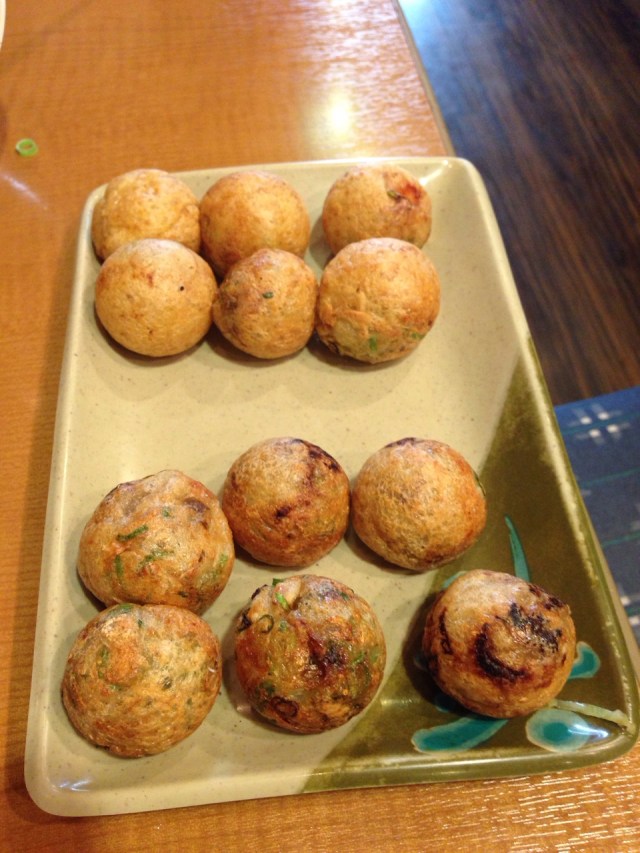
Below is a set of six made of takoyaki batter with green onions and another set of six made of meat and green onions.
Aizuya also sells akashiyaki but is sold as part of a meal set. All around Osaka, there are chains of Aizuya shops, even in metro stations. We traveled to the original location in Osaka, next to the Osaka JR station, only to realize there was a closer shop near the Namba station that we were staying close to.
I was not a whisky drinker before I came to Suntory Yamazaki Distillery. In fact, I knew nothing about whisky except for it’s strong distasteful alcohol flavor. I wanted to broaden my alcohol palette to enjoy whisky the way my friends did, and I was able to accomplish that here.
Founded by Shinjiro Torri, Suntory Yamazaki Distillery is the birthplace of Japanese whisky. Since water is a key factor in determining the quality of whisky, Torri selected to build his empire in Yamazaki due to its exquisite natural spring water “Rikyu no Mizu.” It still bubbles today.
A glimpse of the thousands of bottles that make up the whiskey library.
After fermentation, the wash is distilled twice through the pot still (pictured below) to collect the new make, a highly alcohol concentrated clear, colorless malt whisky.
For my first ever whisky tasting, I tried the Hibiki 17, Yamazaki 18, and Hakushu 18. My friend taught me how to hold the whisky in my mouth, grind it with my teeth and enjoy the smokiness that exudes. I think I had too much fun doing this that at times I would choke on the intense smokiness.
Hibiki is a blend of pure single malt whiskies aged in a variety of casks to create one single harmonious orchestra of flavors and aromas. Yamazaki is known to be Suntory’s flagship single malt, multi-layered with fruit and Mizunara, a very rare Japanese oak, aroma. Hakashu is the herbal and gently smoky single malt from the untouched Mt. Kaikomagatake of the Southern Japan Alps.
Tastings ranging from $15-$40 dependent on the blend and age. Tip: Yamazaki is located in between Osaka and Kyoto. When you’re on your way to Kyoto from Osaka, just make a pit stop for some whisky.
Kobe beef refers to the Tajima strain of wagyu beef, therefore, only wagyu from Kobe, Japan can be called kobe.
Tsurugyu is known for its grade A Kobe beef. This place is amazing melt in your mouth goodness. Be ready to drool over the following epic food.
Placing the hot, fiery coals to grill the luscious meat.
The most delicious cow tongue, which is then dipped in lemon, salt and pepper dipping sauce.
Two cuts of rib eye steak full of natural umami.
Close up natural beauty shot.
Melt in your mouth kalbi (short rib).
Marinated belly goodness.
Cold handmade noodle soup.
To end the meal, they provided an ume (plum) tea and matcha green tea.
Overall, this was the best meal I had in Japan.
We were lucky and got to sit at the counter and watch the chef prepare the meat. He also kept an eye on us to ensure we didn’t overcook any of the precious meat, which was fine with me since I believe the chef knows all. All of the beef was rich and melted in your mouth. Each cut of meat had a special dipping sauce, so it was swapped out with every cut of meat. All of this cost about 60 USD per person, which is cheap for kobe wagyu. A must try when in Osaka.
Umeda Sky building consists of a pair of skyscrapers connected by a floating garden observatory, depicted above, with a 360 degree view of Osaka. The mirrors reflect the sky to give the observatory a floating effect.
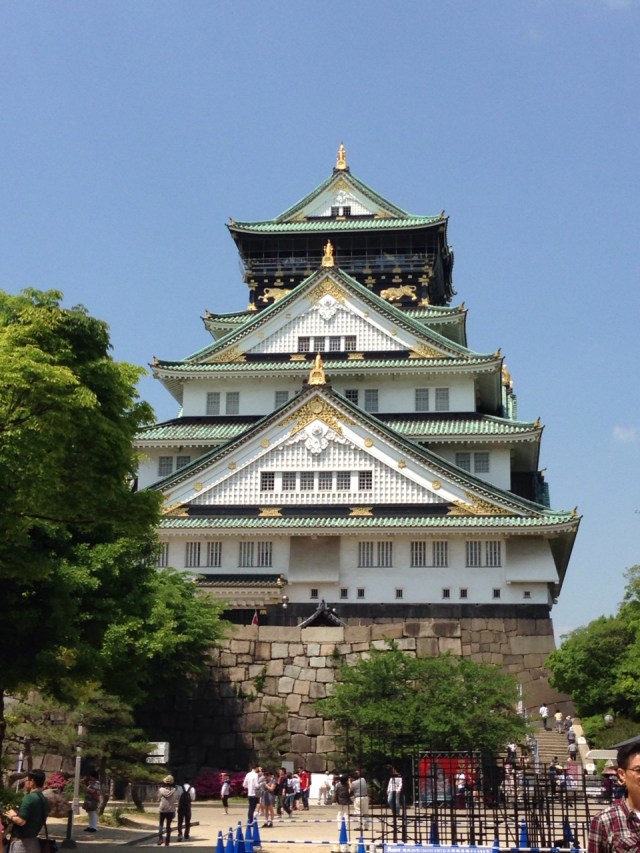
Osaka Castle played a major role in the unification of Japan in the sixteenth century. In 1583, Toyotomi Hideyoshi began the construction of the castle featuring eight stories, five stories main tower and three stories underground.
Despite it being an iconic landmark of Osaka, it has been rebuilt several times due to sieges and being burnt down multiple times. In 1615, Tokugawa Ieyasu seiged the castle from Toyotomi Hideyori, the heir of Toyotomi Hideyoshi.
In 1620, it was reconstructed by Tokugawa Hidetatada, son of
Tokugawa Ieyasu. In 1655, lightning struck the main tower and burned it down. The current castle is a restoration, completed in 1997, representation of the Toyotomi period. The interior is now a museum of the history of Osaka Castle.
Before you is the amazing Osaka Castle. Just kidding. It’s one of the few remaining turrets.
The south half of the inner moat is grass while the north half is filled with water. This was how it was during the Toyotomi period and has remained that way since.
The inner stone wall was built in 1620 and still stands today. The granite boulders, from a rock quarry in Seto Inland Sea Rock, interlock together without mortar.
View of Osaka from the top floor with half of the golden Shachihoko. It is a mythical creature with a dragon head and fish body and symbolizes prestige and authority.
A little unknown secret is Endo Sushi, located in Osaka’s fish market. There is approximately only a 10 min wait. The place is small and they will seat you with strangers at the same table. They offer 5 different sushi sets options for ¥1050 each. Each set comes with 5 pieces if nigiri.
I got two sets. The first set came with kani (boiled crab), akagai (arc shell), hotate-bashira (scallop), toro, and tachiuo (hairtail). I looooved the sweetness of the scallop.
My next set came with ika (squid), ikura (salmon roe),
sayori (halfbeak), toro, and sake (salmon). I chose this one because I’m a fan of halfbeak. Overall, the fish was super fresh and sweet.
There are no individual soy sauce plates. It is custom to brush the soy sauce from the communal bowl onto your sushi. If you want miso soup, you can order it as a side.
Osaka’s Dotonburi district is know for okonomiyaki. We got lost looking for this place amongst the crowds in Shinsaibashi and walking around in the rain. Luckily, we found this on the row of restaurants in Dotonburi.
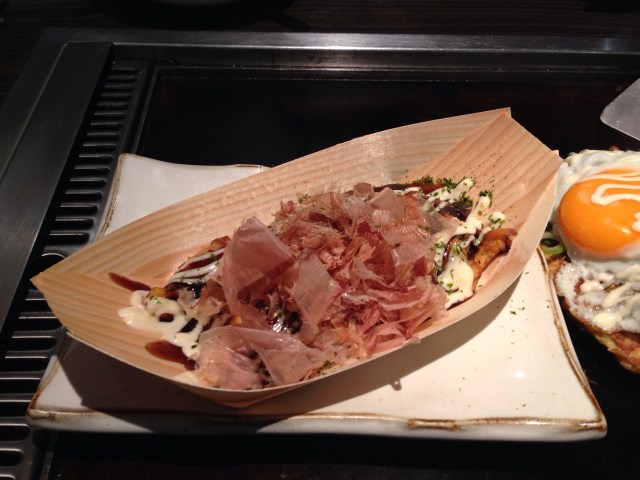
We ordered the oko tako, which is octopus wrapped in egg topped with teriyaki, mayonnaise and bonito flakes. I loved the bonito flakes because they were bursts of flavor compared to the bland ones I’ve had before.
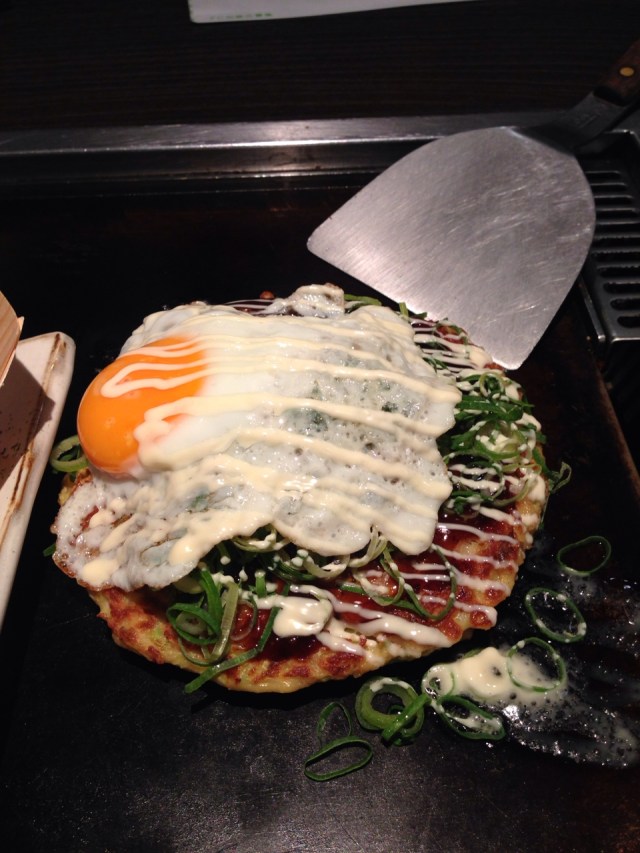
On the okonomiyaki with everything i.e. beef, pork, octopus, and squid, we opted for the additional green onions and egg toppings. The okonomiyaki is plated on the grill in the middle of the table.





 YUMTRAVELS