Navigating the World of Japanese Snacks

When I travel, my favorite souvenirs are food. Wherever I travel, I will no doubt come back with cases of snacks. I love to try snacks from different countries because what’s unusual in one country is the norm in a different country. Plus, it allows me to experience different flavor combinations I would never think to go together i.e. butter flavored chocolate.

I tried my best to taste all the snacks, amongst all the meals I ate, but it was a hard feat since there was such a large variety. Japan takes their snacks seriously. Chips, chocolates, and cookies in every flavor combination possible. And then there’s the matcha; it is not JUST matcha. There’s Uji matcha, sakura matcha, matcha with soybean powder, etc. It’s like snacks on steroids. The ones I didn’t have time to try, I brought home to savor. Below is a picture of all the snacks I bought.img_2590
Yes, I fit all the snacks above, 1.5 weeks of clothes, and a bottle of whiskey all in ONE carry on suitcase. I know I’m nuts, but I LOVE my snacks. Here is a breakdown of the snacks I think are worthy of trying:

Continue reading

Suntory Yamazaki Distillery

I was not a whisky drinker before I came to Suntory Yamazaki Distillery. In fact, I knew nothing about whisky except for it’s strong distasteful alcohol flavor. I wanted to broaden my alcohol palette to enjoy whisky the way my friends did, and I was able to accomplish that here.

image

Founded by Shinjiro Torri, Suntory Yamazaki Distillery is the birthplace of Japanese whisky. Since water is a key factor in determining the quality of whisky, Torri selected to build his empire in Yamazaki due to its exquisite natural spring water “Rikyu no Mizu.” It still bubbles today.

image

A glimpse of the thousands of bottles that make up the whiskey library.

image

After fermentation, the wash is distilled twice through the pot still (pictured below) to collect the new make, a highly alcohol concentrated clear, colorless malt whisky.

image

For my first ever whisky tasting, I tried the Hibiki 17, Yamazaki 18, and Hakushu 18. My friend taught me how to hold the whisky in my mouth, grind it with my teeth and enjoy the smokiness that exudes. I think I had too much fun doing this that at times I would choke on the intense smokiness. 

image

Hibiki is a blend of pure single malt whiskies aged in a variety of casks to create one single harmonious orchestra of flavors and aromas. Yamazaki is known to be Suntory’s flagship single malt, multi-layered with fruit and Mizunara, a very rare Japanese oak, aroma. Hakashu is the herbal and gently smoky single malt from the untouched Mt. Kaikomagatake of the Southern Japan Alps. 

Tastings ranging from $15-$40 dependent on the blend and age. Tip: Yamazaki is located in between Osaka and Kyoto. When you’re on your way to Kyoto from Osaka, just make a pit stop for some whisky.

(Japan, 〒618-0001 Osaka Prefecture, Mishima District, 島本町山崎5−2−1)

Kyoto Ramen Koji

Kyoto’s JR station is an architectural beauty one stop shop for transit, shopping and food all in one.  An Isetan department store is located within the station.

image

Amazing view of Kyoto Tower.

image

Go up these stairs to the 10th floor to find Kyoto Ramen Koji, also known as Ramen Alley. There are eight restaurants that cook up ramen from different regions of Japan. 

image

Read the boards to select the type of regional ramen you would like to try and head over to its corresponding location. To order ramen, buy a ticket from the menu vending machines in front of the restaurant. Most of it is written in Japanese but there are pictures. Once you’ve selected the ramen you want, wait in the queue forming along the side of the restaurant.

image

I tried Menya Iroha’s (麺家いろは) glass shrimp, salt seasoned egg ramen. The broth was clear and the medium curly noodles were perfectly chewy. However, they are famous for their “Toyama Black” broth made from boiling fish sauce for many hours until the flavor mellows out. I didn’t try this but definitely will next time.

(Kyoto Station, Shimogyo Ward, Kyoto, Kyoto Prefecture, Japan)

Sagano Bamboo Forest

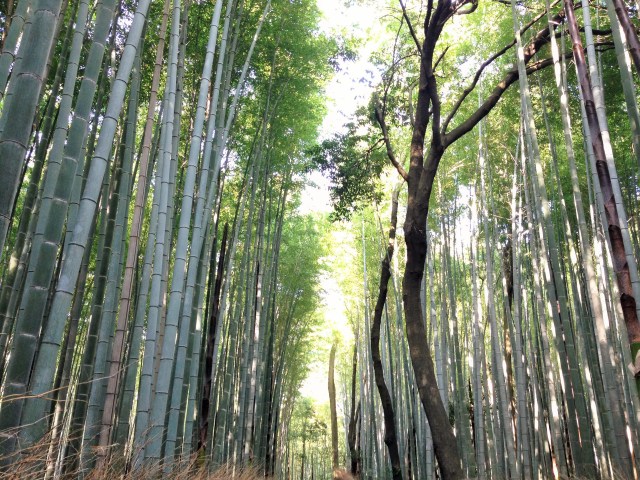
Next to Tenryuji Temple is the infamous Sagano Bamboo Forest. I was very excited to check this out as I was expecting never ending columns and columns of bamboo as the word forest implies. However, it was only approximately two blocks of bamboo and was polluted with people. It was not as calm and peaceful as I hoped it to be.

image

This guy did a great job of portraying the nature of the bamboos.

image

Admission: free

(Sagano, Kyoto, Japan)

Tenryuji Temple (天龍寺)

Tenryuji is the most important zen temple of the Arashiyama district of Kyoto. Built in 1339 by shogun Ashikaga Takaui in honor of late  Emperor Go-Daigo. It is now a UNESCO world heritage site.

image

Zen garden when you first walk into the temple.

image

Many of its original buildings were lost overtime to fire and wars. Its current buildings were rebuilt during the Meiji period. The original garden created by Muso Soseki, the first priest of Tenryuji, still stands today.

image

Overall, I didn’t find this temple to be impressive. Maybe because I saw too many temples and was tired of them at this point. I enjoyed the zen garden of Kodaiji Temple more.

Admission: 500 yen

(Japan〒616-8385 京都府京都市右京区嵯峨天龍寺芒ノ馬場町68)

Arashiyama Monkey Park

Arashiyama monkey park is a park like no other. Fun for kids, teenagers, and adults.

It was my favorite Japan experience.

To get to the heart of the park, you have to hike up steep and sometimes broken terrain. Tip: Wear comfortable shoes and bring water as the trail is mostly in the sun.

image

After 20 minutes of strenuous uphill, you will forget about the hike once you spot the free roaming Japanese macaque monkeys.

image

At the top, there is a feeding hut, which is the only place you are allowed to feed the monkeys. If you feed them outside the hut, they can become aggressive.

image

For 100 yen, you can buy a bag of peanuts or apples to feed the monkeys.

image

The fatty on the left kept stuffing his mouth with peanuts until he became a chubby bunny. I was shocked to see the monkeys knew to reach their hand out for more food.

Outside of the feeding hut, the monkeys roam around freely. However, you are not allowed to make eye contact with the monkeys or touch them.

This little guy was my favorite. 

image

Instead of asking for food, he decided to hunt for his own.

Peace out homies. It’s naptime. Fun fact: The monkeys have red faces due to the blood rushing to their face.

image

Last but not least, don’t forget to turn around and enjoy the gorgeous view of Kyoto.

image

Admission: 400 yen

(Japan〒616-0007 京都府京都市西京区嵐山元録山町8)

Togetsukyo Bridge

To get to Arashiyama, you will come across the beautiful Togetsukyo Bridge, also known as “Moon Crossing Bridge.”

The bridge divides the river into two. West of the bridge, the river is named Hozu River while east of the bridge, the river is named Katsura River.

On the east side, enjoy the scenic view on a kayak.

(Arashiyama, Kyoto, Japan)

Kamo River (Kamo-gawa)

Kamo river is a great place to stroll or have a picnic when the weather is nice in Kyoto. 

image

Parallel to the river are restaurants with extended balconies to create a nice dining experience.

image

(Gion, Kyoto, Japan)

Kinkakuji (The Golden Pavilion)

Formally known as Rokuon-ji Temple, but infamously known as Kinkakuji or the Golden Pavilion, this temple was built during the Muromachi period. It was previously the retirement villa of the third shogun Ashikaga Yoshimitsu but became a zen temple after his death.

image

Gold foil covers the top two levels of the temple while a phoenix sits atop the temple.

image

You are allowed to roam the rest of the temple grounds, however, there is not much to see.

Admission: 400 yen

(1 Kinkakujicho, Kita Ward, Kyoto, Kyoto Prefecture 603-8361Japan)

Kodaiji Temple

Kodaiji temple was my favorite temple on this trip. The zen qualities of the temple was soothing among the busy rhythm of this trip.  

image

This temple was built in 1605 by Kita-no-Mandokoro, also known as Nene, in honor of her late husband Toyotomi Hideyoshi. However the temple is named after Kita-no-Mandokoro’s honorary name Kodai-in. 

image

Peaceful zen stone garden in front of the main hall. 

image

Kaisan-do, Founder’s Hall, with bonsai trees.

image

Hojo, main hall, rebuilt after being burned down in 1912.

image

Garyoro corridor, named after the resemblance to the back of a reclining dragon.

image

Mausoleum enshrining Toyotomi and Nene.

image

Shigure-tei teahouse constructed by bamboo and logs interwoven in a radiating pattern.

image

Next up on my house plans will be a bamboo forest.

image

Huge goddess statue.

image

Admission: 500 yen

(Japan, 〒605-0825 京都府京都市 東山区下河原町八坂鳥居前下る下河原町526)