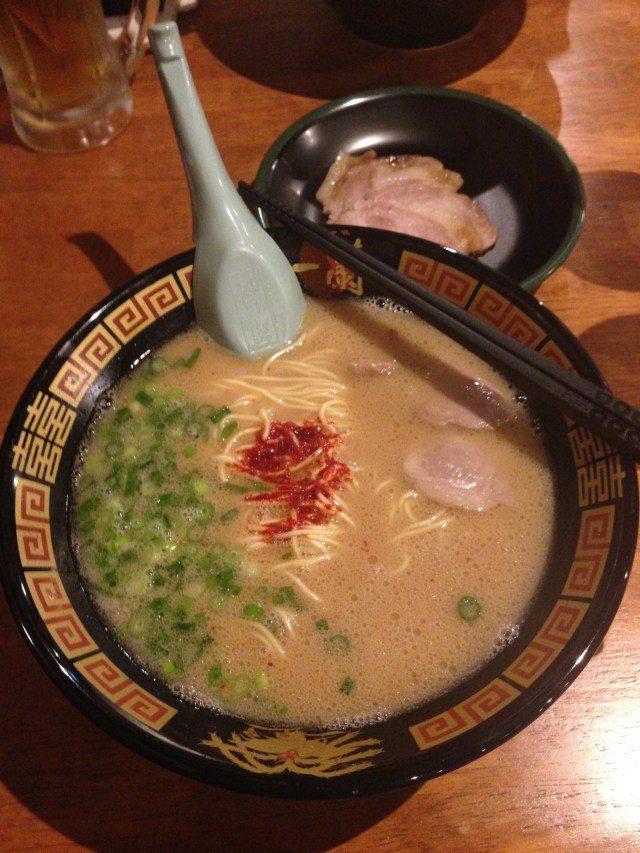
Like everything else in Japan, Ichiran is a chain restaurant. They specialize in ramen with tonkotsu broth. To order, buy your meal ticket at the vending machine. You have the option to add more pork, green onions or an egg for additional costs. Once you’ve purchased your meal ticket, the hosts will guide you to an open table. You have the option to sit at individual booth like eating area or at open tables. At the table, you fill out a form customizing your broth and noodle preferences. The broth was porky but not deep in flavor. The noodles were the perfect chewiness. One dislike was that they forgot our egg until I remembered at the end of meal. Overall, it was a satisfying bowl of ramen.
Next to Dotonbori is Osaka’s shopping mecca Shinsaibashi. You can easily get lost in the never ending row of stores selling clothes, souvenirs, and jewelry. Beware of the hordes of tourists. I was expecting the tourists to be in Tokyo but soon learned they were all in Shinsaibashi.
Lured by the sweet fresh out of the oven smell of a cream puff, I stopped at the Hop Chou a la Creme stall for a chocolate cream puff filled with matcha custard. The shell was crispy and the matcha cream was sweet and delicious.
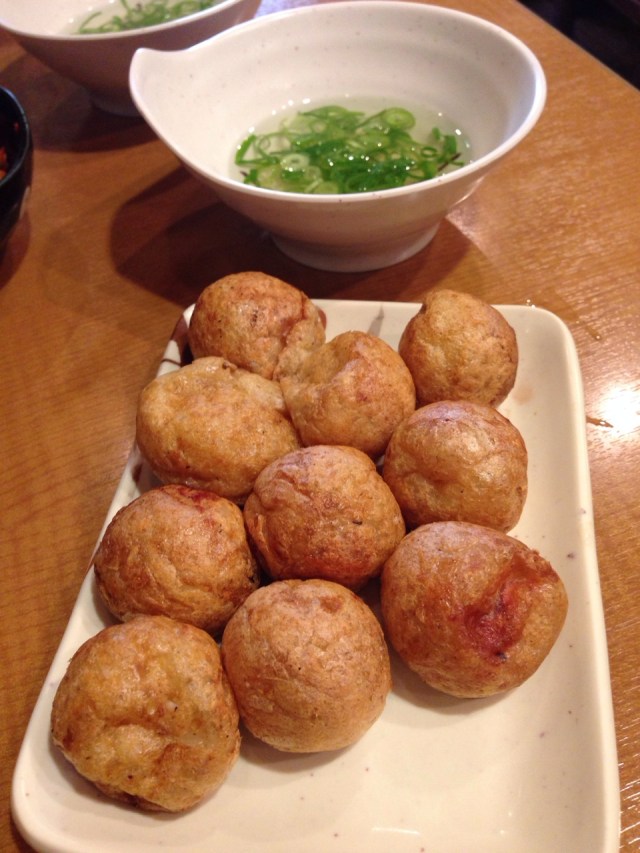
Aizuya is the birthplace of takoyaki. Tako means octopus and yaki means to fry or to cook in Japanese. Due to food shortages in the twentieth century, wheat flour was sent over to Japan by the US as a relief after World War II. It became more popular than rice, which wasn’t sustainable until recently. Endo Tomekichi used the flour to create choboyaki, bite sized balls of batter cooked in a special hemispherical grill. At the same time, in Akashi, akashiyaki was developed. It is a piece of octopus surrounded by loose, eggy batter and then is dipped in dashi, a clear fish broth. Tomekichi combined the two recipes and created takoyaki to be sold in his first takoyaki shop, Aizuya. Takoyaki is now one of the staples of Osaka. It is popular on the streets of Dotonbori. Japan’s Universal City Walk also includes a Takoyaki Museum for takoyaki lovers.
Below is the original takoyaki. The original recipe does not include sauces or toppings.
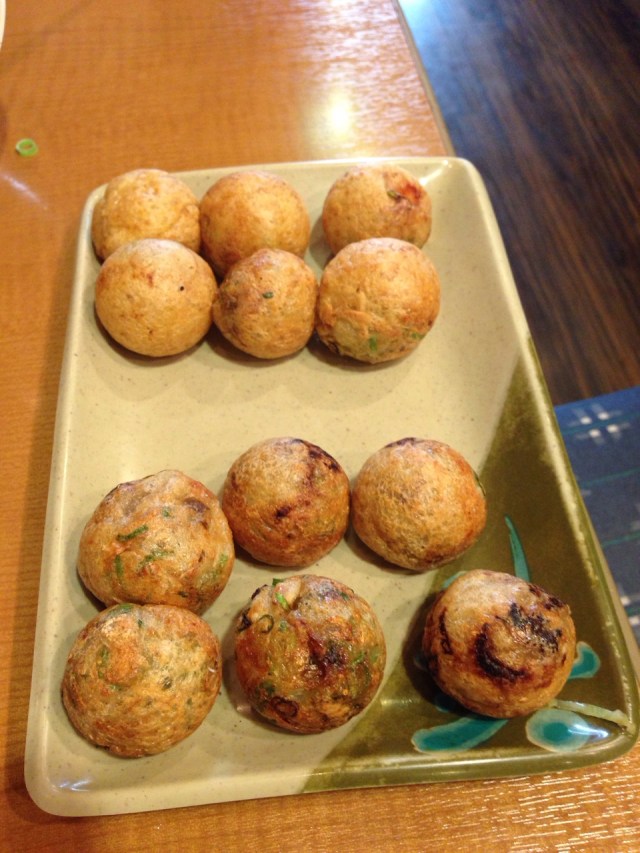
Below is a set of six made of takoyaki batter with green onions and another set of six made of meat and green onions.
Aizuya also sells akashiyaki but is sold as part of a meal set. All around Osaka, there are chains of Aizuya shops, even in metro stations. We traveled to the original location in Osaka, next to the Osaka JR station, only to realize there was a closer shop near the Namba station that we were staying close to.
I was not a whisky drinker before I came to Suntory Yamazaki Distillery. In fact, I knew nothing about whisky except for it’s strong distasteful alcohol flavor. I wanted to broaden my alcohol palette to enjoy whisky the way my friends did, and I was able to accomplish that here.
Founded by Shinjiro Torri, Suntory Yamazaki Distillery is the birthplace of Japanese whisky. Since water is a key factor in determining the quality of whisky, Torri selected to build his empire in Yamazaki due to its exquisite natural spring water “Rikyu no Mizu.” It still bubbles today.
A glimpse of the thousands of bottles that make up the whiskey library.
After fermentation, the wash is distilled twice through the pot still (pictured below) to collect the new make, a highly alcohol concentrated clear, colorless malt whisky.
For my first ever whisky tasting, I tried the Hibiki 17, Yamazaki 18, and Hakushu 18. My friend taught me how to hold the whisky in my mouth, grind it with my teeth and enjoy the smokiness that exudes. I think I had too much fun doing this that at times I would choke on the intense smokiness.
Hibiki is a blend of pure single malt whiskies aged in a variety of casks to create one single harmonious orchestra of flavors and aromas. Yamazaki is known to be Suntory’s flagship single malt, multi-layered with fruit and Mizunara, a very rare Japanese oak, aroma. Hakashu is the herbal and gently smoky single malt from the untouched Mt. Kaikomagatake of the Southern Japan Alps.
Tastings ranging from $15-$40 dependent on the blend and age. Tip: Yamazaki is located in between Osaka and Kyoto. When you’re on your way to Kyoto from Osaka, just make a pit stop for some whisky.
Kyoto’s JR station is an architectural beauty one stop shop for transit, shopping and food all in one. An Isetan department store is located within the station.
Amazing view of Kyoto Tower.
Go up these stairs to the 10th floor to find Kyoto Ramen Koji, also known as Ramen Alley. There are eight restaurants that cook up ramen from different regions of Japan.
Read the boards to select the type of regional ramen you would like to try and head over to its corresponding location. To order ramen, buy a ticket from the menu vending machines in front of the restaurant. Most of it is written in Japanese but there are pictures. Once you’ve selected the ramen you want, wait in the queue forming along the side of the restaurant.
I tried Menya Iroha’s (麺家いろは) glass shrimp, salt seasoned egg ramen. The broth was clear and the medium curly noodles were perfectly chewy. However, they are famous for their “Toyama Black” broth made from boiling fish sauce for many hours until the flavor mellows out. I didn’t try this but definitely will next time.
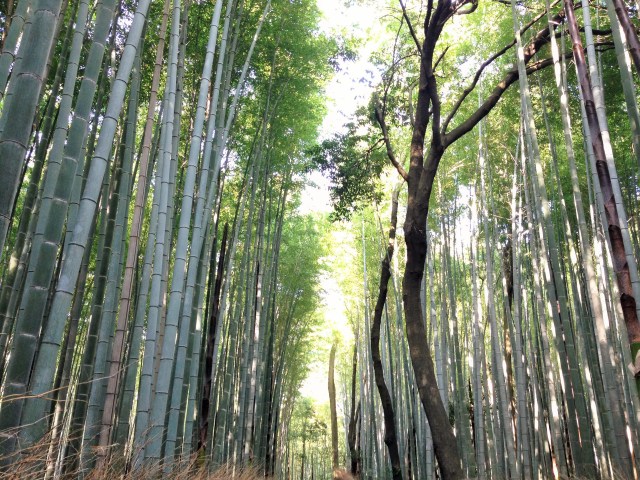
Next to Tenryuji Temple is the infamous Sagano Bamboo Forest. I was very excited to check this out as I was expecting never ending columns and columns of bamboo as the word forest implies. However, it was only approximately two blocks of bamboo and was polluted with people. It was not as calm and peaceful as I hoped it to be.
This guy did a great job of portraying the nature of the bamboos.
Tenryuji is the most important zen temple of the Arashiyama district of Kyoto. Built in 1339 by shogun Ashikaga Takaui in honor of late Emperor Go-Daigo. It is now a UNESCO world heritage site.
Zen garden when you first walk into the temple.
Many of its original buildings were lost overtime to fire and wars. Its current buildings were rebuilt during the Meiji period. The original garden created by Muso Soseki, the first priest of Tenryuji, still stands today.
Overall, I didn’t find this temple to be impressive. Maybe because I saw too many temples and was tired of them at this point. I enjoyed the zen garden of Kodaiji Temple more.
To get to the heart of the park, you have to hike up steep and sometimes broken terrain. Tip: Wear comfortable shoes and bring water as the trail is mostly in the sun.
After 20 minutes of strenuous uphill, you will forget about the hike once you spot the free roaming Japanese macaque monkeys.
At the top, there is a feeding hut, which is the only place you are allowed to feed the monkeys. If you feed them outside the hut, they can become aggressive.
For 100 yen, you can buy a bag of peanuts or apples to feed the monkeys.
The fatty on the left kept stuffing his mouth with peanuts until he became a chubby bunny. I was shocked to see the monkeys knew to reach their hand out for more food.
Outside of the feeding hut, the monkeys roam around freely. However, you are not allowed to make eye contact with the monkeys or touch them.
This little guy was my favorite.
Instead of asking for food, he decided to hunt for his own.
Peace out homies. It’s naptime. Fun fact: The monkeys have red faces due to the blood rushing to their face.
Last but not least, don’t forget to turn around and enjoy the gorgeous view of Kyoto.





 YUMTRAVELS